

Animal Education
-
How We Care for Species from Three Continents
The animals at The Preserve come from three continents, and no two of them need the same kind of care. An Asian elephant, an African giraffe, and an Australian kangaroo each arrive with their own diet, climate, and daily routine, so caring for them well means recreating a piece of home for every species. Here is how one team does that under one roof in the Texas Hill Country.
-

How Asian Elephants Build Social Bonds
Asian elephants are highly social animals with complex relationships that scientists are still working to fully understand, and recent research shows their friendships can be larger and more fluid than once believed. At The Preserve in Fredericksburg, Texas, that social world comes to life as you watch elephants like Rosie, Kitty, and Becky interact, bond, and move through daily routines together.
-

Meet Our Vets
The veterinary team behind world-class elephant care at The Preserve in Fredericksburg, Texas combines local expertise, specialized elephant medicine, and decades of hands-on experience. From routine health monitoring to advanced care in areas like foot health, ophthalmology, and long-term wellness planning, this collaborative approach ensures the highest standard of care for Asian elephants.
-

ZAA vs AZA: Understanding Zoo Accreditation
Accreditation is one of the clearest indicators of how a zoo or wildlife facility cares for its animals. The Zoological Association of America (ZAA) and the Association of Zoos and Aquariums (AZA) both set standards for animal welfare, education, and accountability, though they serve different types of facilities.
-

Elephant Artwork
Elephants are so intelligent, it’s important that we give them puzzles to solve and projects to complete. After we saw our elephants pick up sticks and draw patterns in the dirt, we decided to teach them how to paint to help keep them mentally stimulated. Different types of artwork encourages the elephants to explore different behaviors and individual elephants will frequently develop their own particular style for each art type.
Artistic style is all about personality.
-

Elephant Tusks
Tusks are modified incisor teeth made of ivory, and a living pulp cavity inside lets them keep growing throughout an elephant's life. Both male and female African elephants can have large tusks. Among Asian elephants, only the males do, while females have small tushes that usually stay hidden behind the upper lip. Tusks are inherited from an elephant's parents, much like eye or hair color in people. Watch our video to see our elephants' tusks up close.
-

Elephant Poop
Elephants eat about 150-200 lbs of food per day, but they have a relatively inefficient digestive system. They only actually digest about 60% of what they eat. This means that 40% comes out the other end as an incredibly useful little package that contains seeds and fertilizer together. This wonderous package gets dropped behind the elephant as it’s walking and then the rest of the herd walks through it all, planting the seeds. This benefits not only the plants, whose range expands to wherever the elephants migrate, but also the other species who rely on those plants for survival. This is one of the ways that elephants are a keystone species. When we protect and conserve elephants, we protect and conserve a wide variety of other species.
Who knew poop was so important?
-

Elephant Teeth
Everything about elephants is big, including their teeth. A full grown elephant’s tooth can be about the size of a house brick. Elephants will have 4 molars in their mouths, that’s it! Two on the top and two on the bottom. They will get 6 sets of teeth throughout their lives. Elephants have a marching molar system, meaning that their teeth come in from the backs of their mouths and move forward pushing their old teeth out at the front of their mouths. The teeth will then fall out in chunks and pieces. This system is very useful because it lets the elephants always have a rough grinding surface with which to chew.
Elephant teeth are jumbo sized.
-

Elephant Evolution
Asian and African elephants are quite different from one another and that’s because they are 2 different species with different ancestors. Asian elephants are more closely related to mammoths and African elephants are more closely related to mastodons even than they are to each other. This evolutionary background means that the two species are so different that they cannot successfully interbreed.
Ancestors make all the difference!
-

Elephant Feet
Elephant feet are made for walking. The structure of their feet includes a cushion which rests underneath and behind the toes, providing support with every step the elephant takes. The cushion expands as the elephant’s foot has contact with the ground and then contracts as their foot lifts. The bottom of the foot is a thick calloused pad. In the wild elephants will wear their feet and nails down by walking and digging. In human care, we provide the elephants with monthly mani/pedis and lots of exercise to make sure their feet stay healthy.
Elephant feet are made for walking.
-

Elephant Endotheliotropic Herpesvirus
EEHV (elephant endotheliotropic herpesvirus) is found in elephants both in the wild and in human care. Most elephants carry the virus their whole lives without getting sick. When it becomes active, though, it can cause hemorrhagic disease and severe internal bleeding. EEHV affects both African and Asian elephants and is most deadly to young calves, who can die within days of their first symptoms if they don't get treatment. There is no approved vaccine yet, so your support is one of the most important ways to help elephants survive this disease.
Let’s stomp out EEHV!
-

Elephants in Asian Culture
Howdah/culture: For thousands of years elephants in human care have assisted man by working in the forests of Asia, building, hauling, logging and even engaging in warfare. For centuries elephants have played an important role in religion. In Hinduism, Lord Ganesha is an elephant headed god and is the lord of success and remover of evils and obstacles. In some Asian cultures, the Baraat, or groom’s wedding procession, is a tradition that developed when a groom would travel for days in order to reach his bride. The groom arriving at his bride’s home on an elephant amid much fanfare is a sign that his family is wealthy and will be able to support his wife and their future children.
-

Kangaroo Pouches
Kangaroos, wallabies, koalas and possums are all marsupials. What sets marsupials apart is that most females carry their young in a pouch, and most species live in Australia and nearby islands. A kangaroo or wallaby pouch keeps the baby, called a joey, safe with mom whether she's eating, hopping or sleeping.
A newborn kangaroo joey is about the size of a jelly bean. Right after birth it crawls into the pouch, where it spends its first months with everything it needs, including milk. It first pokes its head out at around 4 or 5 months, starts exploring outside at about 6 months, and leaves the pouch for good by about 8 months.
Home sweet home!
-

Tortoises
One of the first things we think of when we think about tortoises is their shell. More than just keeping a tortoise safe from predators, the tortoise’s shell is a very important part of their whole body. Tortoise’s can’t actually leave their shells (cartoons have lied to us!). They get to take their house with them, no matter where they go! The shell is completely attached to the tortoise and is actually a part of their skeleton. The ribs, vertebrae and sternum have all fused together to create a solid layer of bone. But just because the shell is hard, doesn’t mean that tortoises can’t feel when we touch their shells. They are able to feel soft touches like a pat and some even like to get scratches!
-

Giraffe Ossicones
Many animals have horns or antlers, but only giraffes and their relative the okapi have ossicones. They may look like fuzzy horns, but they're built differently. Horns are covered in keratin, the same material as fingernails. Ossicones start as cartilage that turns into bone and fuses to the skull as the giraffe grows, and they stay covered in skin and hair for life. Males use them in fights, swinging their heads like clubs, and the ossicones focus the force of each blow. The ossicones and the skin around them have a rich blood supply, so they may also help giraffes cool down.
Ossicones are ossi-awesome!
-

Giraffe Vertebrae
Everything about giraffes is long, especially their neck. That long neck allows giraffes to browse in the highest branches and see incredible distances. It can also be a challenge: have you ever watched a giraffe drink water? Their neck is so long that they can’t just bend their heads down to drink, they actually have to brace their legs in a wide stance in order to reach the water. With such a long neck, it might be surprising to learn that giraffes actually have the same number of vertebrae in their necks as humans do! Humans have 7 vertebra in their necks, and while those in a giraffes neck are much larger, there are also only seven in a giraffes neck. Each vertebra in a giraffes neck can be as long as 10 inches!! With the seven vertebrae, that means a giraffe’s neck can be over 6 feet long!
Talk about a long neck!
-

Giraffe Tongues
Giraffes are known for their long legs and long necks. Did you also know their tongue is incredibly long as well? While it isn’t polite to stick your tongue out at the dinner table, for giraffe’s that long tongue is actually how they eat their dinner! Reaching lengths of up to 18 inches giraffes use their tongue to help grab onto those extra tasty leaves that would otherwise be out of reach.
On top of being extra long, giraffe tongues are also prehensile, which means they can use their tongue to grasp, similarly to how we use our hands. Those tongues also have a dark color on the front half. This is dense melanin which some believe is an adaptation to protect the tongue from sunburn since giraffes spend so much time with their tongues out.
It isn’t rude for a giraffe to stick it’s tongue out.
-

Kookaburra Vocalization
Food whacking: The Laughing Kookaburra is the largest kingfisher, and it eats accordingly. It will eat insects and other invertebrates, but it specializes in larger prey like snakes and lizards. It lacks the strong talons and hooked, meat-ripping beak of a hawk or eagle, so it uses its head. A kookaburra grabs its prey in its large beak and whacks it against a rock or log until it's dead. Then it's time to eat!
Sound: Laughing Kookaburras are named for their call, which they use to claim and defend their territory and which sounds a lot like human laughter. They live in family groups, so when the whole family calls together, it sounds like someone just told a great joke to a crowded room. Hollywood has borrowed the sound for years. If you've heard what you thought were monkeys in a movie jungle scene, there's a good chance it was a kookaburra.
Kookaburras will always laugh at your jokes.
-

Porcupine Quills
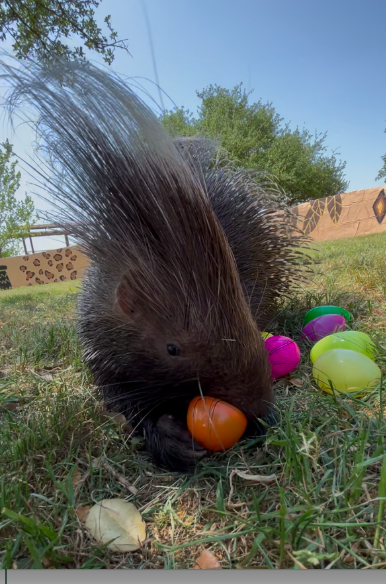
Porcupines evolved quills to protect themselves from predators. Quills are modified hairs that have grown thick and stiff, and no porcupine can shoot them. In some species, such as the North American porcupine, the quills have barbs that keep them stuck in a predator.
African crested porcupines, like the ones at The Preserve, have two kinds of quills. When threatened, a porcupine first rattles the hollow quills on its tail as a warning. If the predator keeps coming, the porcupine backs into it with its sharp quills. These are loosely attached, so they can stick in the attacker and distract it long enough for the porcupine to escape. Because quills are hair, they also shed naturally.
Porcupines are prickly.
Newsletters